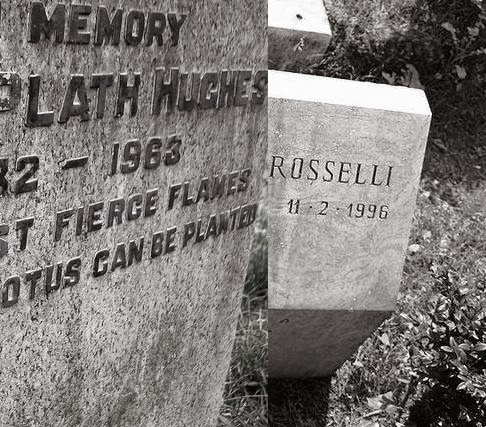
February 11th is a date I cannot forget, being the death anniversary of two women poets I truly love. Sylvia Plath 's death makes of her an iconic martyr immolating herself on the altar of Pain. Reading about her death and her last few acts before sealing the kitchen's door inspired one my poems, " Milk and Bread ," that was first published by editor Cooper Renner in elimae and that can be read in my They Talk About Death chapbook. I am certainly not the only poet who was inspired by Sylvia's death. Thomas Rain Crowe wrote a beautiful poem--"Poem for Sylvia Plath Without Even Lighting the Stove"-- on the subject that you may read here and so did Tania Pryputniewicz in her " Sylvia III ," from her November Butterfly collection. Amelia Rosselli was one of Italy's best women poets. I have always admired her craft in writing her lines in either Italian, English or French. Her mother was English and her father, Carlo Rosselli, was a famous...
I love visceral poets. I love poetry made of flesh and bones, of marrow and heart. And pain. I was seventeen when I first read a poem by Anne Sexton. It was love at first sight. I could not help reading all she wrote from then onward and being so devastated by her words and life. I still retain the magical power with which a sentence of that poem hit me: "My mouth blooms like a cut." If only my verses could be as powerful as this! Anne remains a spirit guide.
Today is Pasolini's 36th death anniversary. He was brutally killed on the night of November 2, 1975 in still unclear circumstances and found the following morning by a blue collar on his way to work. Pasolini is possibly Italy's most important poet after Dante. An amazing intellectual who truly loved the lowest classes, which he celebrated in his deeply profound novels and poems. As Jack Hirschman points out, his three initials stand for "Passion, Provocation and Prophecy." This is so true. I wish to celebrate Pasolini posting Orson Welles' reading one of his poems of which I am also including a translation. "I am a Force of the Past" roars Pasolini. No, he is much more than that. He is still today a Force of the Present and of the Future too. I am a Force of the Past. My love lies only in tradition. I come from the ruins, the churches, the altarpieces, the villages abandoned in the Appenines or foothills of the Alps where my brothers once l...



And beautifully so!
ReplyDeleteexquisite! ;-)
ReplyDelete